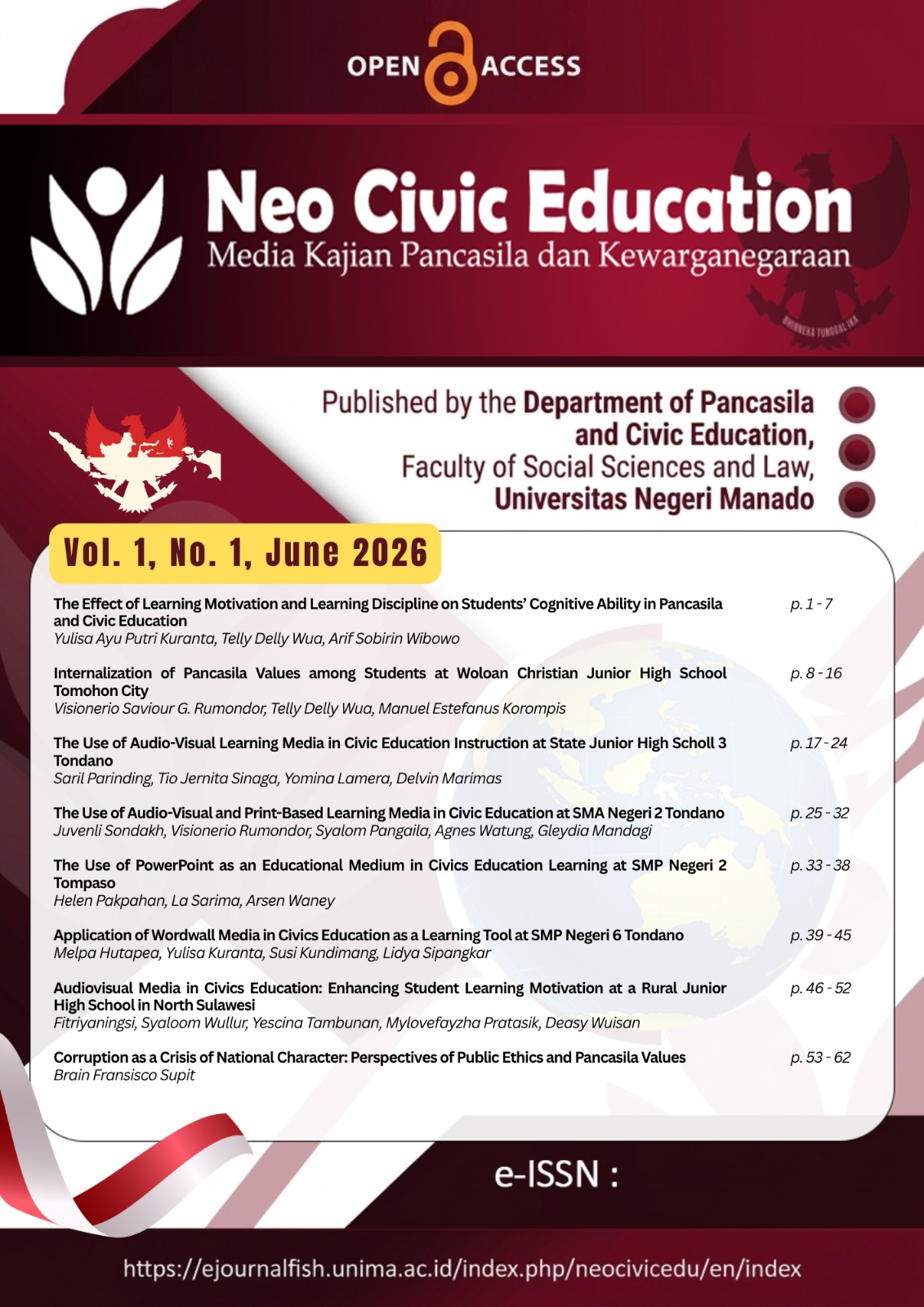
The Effect of Learning Motivation and Learning Discipline on Students’ Cognitive Ability in Pancasila and Civic Education
Keywords:
Learning Discipline, Cognitive Ability, Learning Motivation, Senior High School StudentAbstract
This study aims to analyze the effect of learning motivation and learning discipline on students' cognitive abilities in the subject of Pancasila and Civic Education (PPKn) at SMA Negeri 1 Tabukan Tengah, Sangihe Islands Regency. The background of this research lies in the low levels of students' motivation and learning discipline which have affected suboptimal cognitive achievement. A quantitative approach with a survey design was employed. The sample consisted of 63 students selected using the Yamane formula from a total population of 75 students. Data were collected through Likert-scale questionnaires, observation, and documentation. Instruments were validated using Pearson Product Moment correlation and reliability tested with Cronbach's Alpha. Data analysis included Kolmogorov-Smirnov normality test, linearity test, simple and multiple linear regression, partial t-test, and simultaneous F-test. The results indicate that: (1) learning motivation significantly affects students' cognitive ability (t = 6.043 > t table = 1.999; ρ < .05); (2) learning discipline significantly affects students' cognitive ability (t = 7.613 > t table = 1.999; ρ < .05); and (3) both variables simultaneously exert a significant effect on cognitive ability (F = 36.842; p = .000 < .05). These findings imply that integrating the development of motivation and learning discipline constitutes a key strategy for improving PPKn learning quality at the senior high school level
References
Abdurrahman, M. (2012). Anak berkesulitan belajar: Teori, diagnosis, dan remediasinya. Rineka Cipta.
Ali Imron. (2011). Manajemen peserta didik berbasis sekolah. Bumi Aksara.
Anderson, L. W., & Krathwohl, D. R. (Eds.). (2001). A taxonomy for learning, teaching, and assessing: A revision of Bloom's educational objectives. Longman.
Bjorklund, D. F., & Myers, B. J. (1996). The role of immaturity in human development. Psychological Bulletin, 120(1), 3–25. https://doi.org/10.1037/0033-2909.120.1.3
Bloom, B. S., Engelhart, M. D., Furst, E. J., Hill, W. H., & Krathwohl, D. R. (1956). Taxonomy of educational objectives: The classification of educational goals. Handbook I: Cognitive domain. David McKay.
Creswell, J. W., & Creswell, J. D. (2018). Research design: Qualitative, quantitative, and mixed methods approaches (5th ed.). SAGE Publications.
Deci, E. L., & Ryan, R. M. (1985). Intrinsic motivation and self-determination in human behavior. Plenum Press. https://doi.org/10.1007/978-1-4899-2271-7
Diamond, A. (2013). Executive functions. Annual Review of Psychology, 64, 135–168. https://doi.org/10.1146/annurev-psych-113011-143750
Djamarah, S. B. (2006). Strategi belajar mengajar. Rineka Cipta.
Field, A. (2018). Discovering statistics using IBM SPSS statistics (5th ed.). SAGE Publications.
George, D., & Mallery, P. (2003). SPSS for Windows step by step: A simple guide and reference (4th ed.). Allyn & Bacon.
Ibda, F. (2015). Perkembangan kognitif: Teori Jean Piaget. Intelektualita, 3(1), 27–38.
La Doni, Biringan, J., & Pangalila, T. (2021). Hubungan kedisiplinan siswa terhadap hasil belajar siswa kelas VIII pada mata pelajaran PKn di SMP Negeri 1 Kabangka Kabupaten Muna. Jurnal Civic Education: Media Kajian Pancasila dan Kewarganegaraan, 4(2), 52–64. https://doi.org/10.36412/ce.v4i2.2571
Magdalena, I., Islami, N. F., Rasid, E. A., & Diasty, N. T. (2020). Tiga ranah taksonomi Bloom dalam pendidikan. EDISI, 2(1), 132–139. https://doi.org/10.54082/edisi.13
Pangalila, T. (2017). Peningkatan civic disposition siswa melalui pembelajaran pendidikan kewarganegaraan (PKn). Jurnal Pendidikan Kewarganegaraan, 7(1), 91–103.
Pintrich, P. R., & Schunk, D. H. (2002). Motivation in education: Theory, research, and applications (2nd ed.). Merrill Prentice Hall.
Santrock, J. W. (2018). Educational psychology (6th ed.). McGraw-Hill Education.
Sardiman, A. M. (2012). Interaksi dan motivasi belajar-mengajar. RajaGrafindo Persada.
Schunk, D. H., & DiBenedetto, M. K. (2020). Motivation and social cognitive theory. Contemporary Educational Psychology, 60, 101832. https://doi.org/10.1016/j.cedpsych.2019.101832
Slameto. (2015). Belajar dan faktor-faktor yang mempengaruhinya (6th ed.). Rineka Cipta.
Wahyono, B. (2012). Disiplin belajar dan pengaruhnya terhadap prestasi siswa. Jurnal Pendidikan Ekonomi, 5(1), 1–14.
Yamane, T. (1967). Statistics: An introductory analysis (2nd ed.). Harper & Row.
Zimmerman, B. J. (2000). Self-efficacy: An essential motive to learn. Contemporary Educational Psychology, 25(1), 82–91. https://doi.org/10.1006/ceps.1999.1016